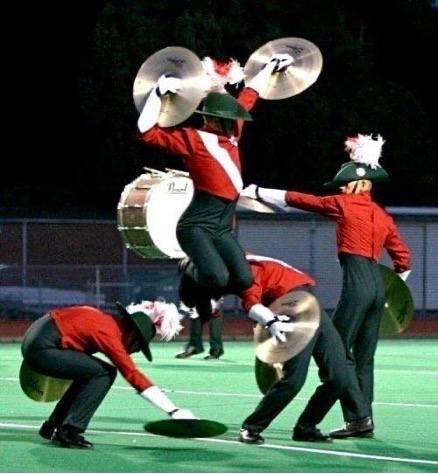
Most drum corps fans have had the thrill of watching the various Santa Clara Vanguard Cymbal Lines through the years with their amazing talent, strength, and finesse watching these championship cymbal players. Through the decades many drum corps discontinued their use of cymbal lines but have since brought them back because of SCV not to mention WGI percussion who feature cymbal lines. When other drum corps were drifting away from carrying cymbal lines, Santa Clara reinvested in what they had and took cymbal lines to a whole new level. So when one talks about cymbal lines, just about every drum corps and band look to the Santa Clara Vanguard who have set the bar high for what a cymbal line can be.
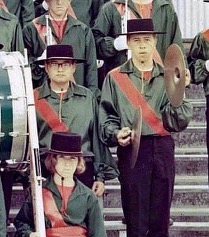
It wasn’t always that way – almost but not quite. If you look at the first official picture of the Santa Clara Vanguard in 1967 you will notice that the two cymbal players are only holding one set of cymbals. Early on SCV only had one set of cymbals. For our Holy Ghost Parades only one of our cymbal players would have our only set and play them from the picnic grounds to the church. Then on the way back from the church he would hand off the cymbals to the other cymbal player so that they both had a chance to play. At field competitions we would ask other corps (mainly the Commodores) if we could use a set of cymbals along with a bass drum. We just couldn’t afford a second set of cymbals that first half year. The two cymbal players that year were Mike Munoz who later went on to be a bass drummer then SCV Drum Major in 1970 and Jim Amador who marched in ’67, ‘68 and ’70.
Through the ’67 season the corps finally had enough money to buy that second set of cymbals which made our two members extremely happy!
In those early years of drum corps cymbal lines were just used as an accent to make a cymbal crash at the right moment – “one, two, three, crash”. Not a lot of finesse or difficulty in their program but that quickly changed. As the cymbal line grew after that first year with more cymbals, they would try new things by making timely patterns that would add some color to the drill that you could see from high up in the stands.
In 1970, during the opening, one of the members suggested a spectacular fan move along with the opening crash. That’s when we heard Fred Sanford yell from the stands, “leave it in”. That spurned the beginning of cymbal line innovation. The line then went on to add more “flash” into the show and Fred Sanford pretty much approved all of them. The cymbal group continued innovations and started adding some flair to their parts where they would do maybe three crashes in a row but high up in the stands you would first see the front cymbal player crash his cymbal then spread them out wide, then the next beat the second cymbal player would crash his cymbals and spread them out wide, same with the third, and then the last one with the huge cymbals would hit the last beat and spread these huge cymbals out wide making a flashy pattern from high up in the stands that stood out. They would call Fred Sanford and Pete Emmons over to watch each new innovation they came up with. In the end it thrilled them to no end all to hear Fred say, “Leave it in!” That started a tidal wave of new ideas from the cymbal line!
From that moment on that SCV group of cymbal players set the high bar for the rest of the drum corps. Everyone wanted to see what SCV was doing. Prior to that point many corps used these small spinning cymbals that only spun and didn’t crash too well (Troopers/Madison). Those quickly died off and most corps started following SCV’s style.
From that point in 1970 onward, the cymbal line started going beyond what could be done with a set of cymbals. It wasn’t just a simple cymbal crash, it was movement, view from the stands, flipping, taps, and the cymbal moves grew from there. Each season new cymbal players coming into Santa Clara started adding their own special touch of what could be done to make this cymbal line even greater. From those early years to today’s SCV cymbal line, the improvements continued. Each new cymbal line came up with a new tradition to add their mark on top of previous lines.
Today when you watch the “VIPER” or the “MATRIX” or the “V” being done by the current Santa Clara Vanguard cymbal line, it just blows your mind to see how well these performers execute with their timing, their speed, and the finesse of these amazing talented SCV Cymbal players.
If you have the opportunity, look inside the SCV equipment truck where they store the corps SCV cymbals for today’s lines, you will see mounted there, a signed SCV license plate of the two original SCV Cymbal Players from 1967, Mike Munoz & Jim Amador.
What they started so many years ago lives on! TNPLSC!!!
Best to all!
-JJA